







NVIDIA vs AMD: Which Graphics Card Is Better for Your Computer?
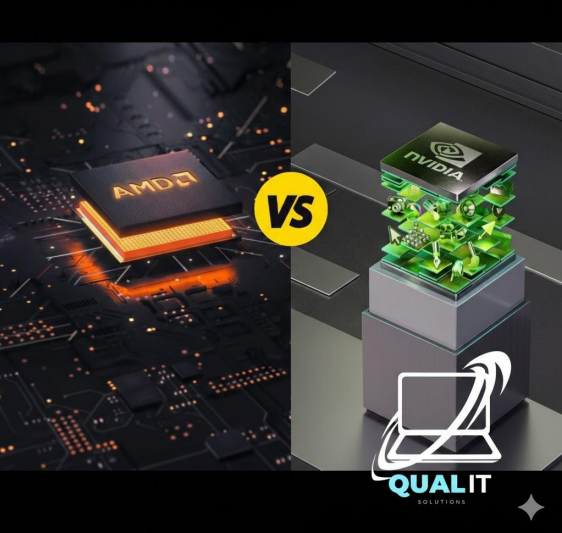
Nvidia is best for cutting edge features, ray tracing, AI tools, and top tier performance. AMD is best for price-to-performance, more affordable options, and flexible compatibility. Your ideal GPU depends on your budget, the games you play, and whether you prefer premium features or overall value.
AMD vs. NVIDIA: What’s the Difference?
The most basic difference between AMD GPUs and Nvidia GPUs is their approach to performance and value. Nvidia cards tend to dominate the high end market with more powerful hardware, advanced ray tracing, and AI-driven features, while AMD cards are known for offering excellent performance at lower price points and a user-friendly software experience.
AMD and Nvidia are the two leading graphics card manufacturers, and their long-running competition has produced a wide range of GPUs suited for different needs, from budget gaming to professional content creation. While their flagship models often compete closely, AMD typically stands out in affordability, especially for entry level and mid range buyers. Nvidia, meanwhile, focuses on cutting-edge technologies and premium performance for users willing to pay more.
AMD vs. NVIDIA GPU: Prices
Both companies release graphics cards across multiple price tiers, but AMD usually offers better value in the budget and mid-range segments. It’s often possible to find an AMD GPU that delivers similar gaming performance to a more expensive Nvidia counterpart. This makes AMD attractive for students, casual gamers, or anyone building a cost efficient PC.
Nvidia’s pricing becomes more competitive at the higher end, where its GPUs justify the cost through exclusive features and superior ray tracing capabilities. Buyers who want the absolute best performance, especially for 4K gaming or demanding creative workloads, often lean toward Nvidia despite the higher price.
AMD vs. NVIDIA: Gaming Performance
When it comes to standard gaming performance at 1080p and 1440p, AMD cards frequently match or even outperform Nvidia cards within the same price range. Their GPUs are optimized for delivering high frame rates in traditional rendering scenarios, making them ideal for most modern games.
However, Nvidia has a clear advantage in advanced graphical technologies. Its DLSS (Deep Learning Super Sampling) uses AI to boost performance while maintaining visual quality, allowing smoother gameplay at higher settings. This is particularly helpful in demanding titles that use ray tracing a technology that simulates realistic lighting, reflections, and shadows. AMD offers a similar feature called FSR (FidelityFX Super Resolution), which improves performance across many GPUs, but Nvidia’s solution is often considered more refined in visual output.
Features, Compatibility, and Drivers
Nvidia emphasizes proprietary technologies such as G-Sync for adaptive sync monitors, CUDA for professional software acceleration, and NVENC for high quality streaming. These features make Nvidia popular among content creators and competitive gamers. AMD focuses on open standards like FreeSync, which works on a wider range of monitors and typically costs less, improving accessibility.
Driver support from both companies has improved significantly. Nvidia is known for fast game-ready driver releases, while AMD provides a feature rich software suite that includes performance tuning, recording tools, and system monitoring in one interface.
Summary
Choosing between AMD and Nvidia depends on your priorities. Nvidia is ideal for users seeking maximum performance, advanced graphics features, and professional tools. AMD is better suited for those who want strong gaming performance, affordability, and broader compatibility. Both brands deliver powerful GPUs capable of handling modern games and demanding applications, ensuring that whichever you choose, you’ll have a capable graphics solution for years to come.
