






From Dial-Up Screeches to AI Websites: The Wild History of the Internet
Ah, the Internet. That magical place where you can binge cat videos, argue with strangers, and finally prove that your conspiracy theory is “research-based.” But did you know it started out as a clunky, awkward teenager? Buckle up, because the history of the Internet and web development is wilder than your Wi-Fi dropping mid-Zoom call.
The Birth of the Internet: Nerds with Big Ideas
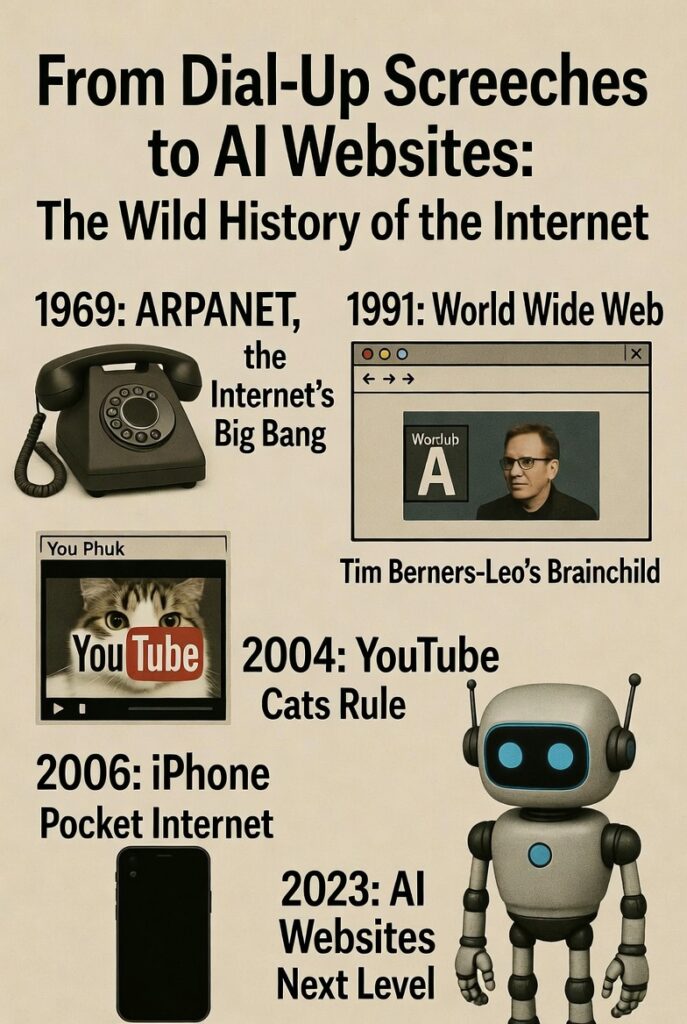
Back in the 1960s, when bell-bottoms were cool and computers filled entire rooms, a group of nerds dreamed of connecting machines across the country. ARPANET, the granddaddy of the Internet, wasn’t made for memes or shopping it was for scientists to share research. Imagine sending an email that looked like a typewriter note. Glamorous, right?
Dial-Up: The Internet Screech Symphony
Fast forward to the 1990s. If you grew up with dial-up, you know the sound: bzzt-zzzz-screeeech-brrrrrrt… connected! That was your modem singing the anthem of the Internet. Downloading a single image could take longer than your favorite sitcom episode. And heaven forbid someone picked up the phone mid-download you were back to square one.
Web Development Goes “Hello, World”
The early web was… let’s say, charmingly basic. HTML was king, websites were mostly text, and GIFs ruled the world (and still haunt us). Developers were like wizards waving their code wands one missing semicolon, and poof! The entire page broke. CSS came along later to make things pretty, and suddenly web design went from “I coded this in five minutes” to “Wow, this looks like actual magic!”
The Dot-Com Boom: Buy All the Unicorns!
The late ’90s and early 2000s saw companies throwing money at anything with a “.com” at the end. Pets.com? Sure. Webvan? Why not. The bubble burst eventually, leaving us with lessons, some memes, and a deep respect for sustainable tech startups. But web development had leveled up, with JavaScript making websites interactive instead of just looking like a Word document online.
Social Media, Streaming, and the Rise of Everything
Then came Web 2.0 the Internet’s glow-up. Suddenly, websites weren’t just for reading; they wanted to talk back. Facebook, YouTube, Twitter, and Instagram turned us all into creators, critics, and meme lords. Web developers had to learn new tricks APIs, responsive design, and how to survive the wrath of angry Twitter users.
Today: AI, Cloud, and Whatever Comes Next
Now, in 2026, the Internet is faster, smarter, and more invasive than ever. AI websites can write, draw, and even argue with you (sometimes scarily well). Cloud hosting means your data floats somewhere in the ether while you bingewatch your favorite shows. And web developers? They’re superheroes juggling HTML, CSS, JavaScript, AI integration, and TikTok embeds without breaking a sweat.
The Takeaway
From ARPANET to AI, the Internet has been a rollercoaster of screechy modems, clunky HTML, and revolutionary ideas. Web development has grown alongside it, turning from hobbyist experiments into full-on digital craftsmanship. So next time you click “refresh” and curse your Wi-Fi, remember you’re part of a history that’s equal parts chaos, genius, and memes.
The Internet didn’t just connect computers; it connected humans, ideas, and let us all share that one cat video that changed our lives forever.
